
Skip to main content
What Can We Help You Find?
Categories
-
Policy & Regulation4
-
Organics3
-
EPR & Stewardship4
-
BC Landfill Information1
-
Plastics2
-
Building Waste Diversion2
-
Funding1
-
BC Solid Waste Information7
-
Emergency Debris6
-
Reuse & Repair Resources1
-
Compilations, Data, Statistics2
-
Education Resources1
-
Hazardous Waste0
-
Textile Waste Information1
EPR in British Columbia: A Timeline of Success and Challenge (2024)
New to EPR in BC? Start here.
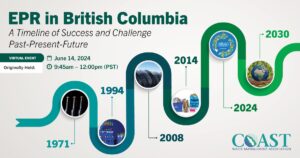
EPR in British Columbia: A Timeline of Success and Challenge | Past, Present, Future was a CWMA special event held on June 14, 2024. It covers how the BC model came about and where it is heading.
- Watch the EPR history event recording: RECORDING
- Resource Recycling also covered the event as an article: EPR of the past, present and future in British Columbia
History of EPR in British Columbia: timeline
- 1917: After prohibition, brewers start reusing bottles. This later becomes the Brewers Recycled Container Collection Council (BRCCC), formalized in 1971.
- 1970–71: BC’s Litter Act passes (March 1970) and takes effect January 1, 1971, starting the deposit-return system for beverage containers.
- 1989: Environmental handling fees on tires ($3) and lead batteries ($5) are added under the Social Services Tax Act. This was a government-run stewardship model.
- 1990: The EPR concept is introduced in Sweden. The BC Hazardous Waste Management Corporation forms to fund household hazardous waste roundups and is later shut down because of rising costs.
- 1994: The Paint Regulation becomes North America’s first EPR regulation. BC Paint Care and Encorp Pacific (Return-It) are formed.
- 1996–2001: Return-It expands to juice, water, cartons, wine, spirits and coolers.
- 1997: The Post-Consumer Residual Stewardship Program Regulation adds solvents, pesticides, gasoline and pharmaceuticals. This sets up BC’s results-based model, where producers can choose a stewardship plan or prescriptive rules.
- 2004: That regulation becomes today’s Recycling Regulation.
- 2009: CCME adopts the Canada-wide Action Plan for EPR, phasing more products in nationally. Return-It adds bear-proof bins in BC Parks.
- 2011–2014: Packaging and paper are added to the regulation (2011), MMBC forms (2012), and the province-wide program launches (May 2014).
- 2013–2019: Return-It adds more convenient options: Express (2013), standalone locations (2014) and Express & Go (2019).
- 2017–2019: MMBC becomes Recycle BC. Its second program plan is approved, and an audit centre opens.
- 2020–2023: A unified 10¢ deposit is introduced (2020). Milk containers (2022) and single-use items like straws and utensils (2023) are added. Recycle BC invests in sorting and flexible plastics recycling.
- 2024 (status at the time of the webinar):
- 14 stewardship agencies are operating and running joint remote-community collection and disaster cleanup.
- Return-It recovery is about 80%, and Recycle BC’s overall recovery is about 80%.
- Paint programs now exist in all 10 provinces and in many US states.
- Looking ahead:
- EPR for packaging and paper is expected in most provinces by 2026, with more materials covered and coverage beyond households.
- BC is expected to stay results-based, with more products and more collaboration between programs.