CWMA Waste Stream Watch

INDUSTRY CHALLENGE BRIEF

Mattresses


Summary

Mattress waste represents one of BC’s most persistent solid waste challenges, with few jurisdictions achieving cost recovery. The bulky, non-compacting nature of mattresses creates operational headaches—damaging equipment, creating fire hazards, and taking up airspace in landfills.

Regional approaches vary widely: Metro Vancouver processes over 90,000 units annually through commercial recyclers, Columbia Shuswap has developed a local deconstruction model that survived atmospheric river disruptions, and Peace River Regional District piloted a shredding program, achieving 75% volume reduction.

After appearing in the province’s 2021-2026 EPR Action Plan, mattresses were removed from consideration in July 2025 due to affordability concerns, leaving local government to continue to shoulder costs. Multiple regional districts are advocating for reconsideration.

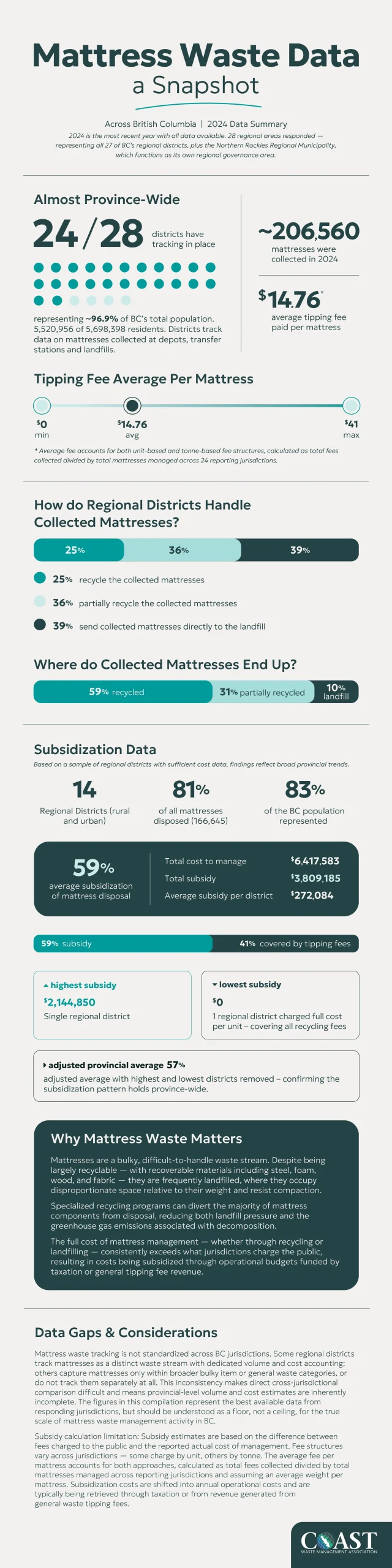
In late 2025/early 2026, the CWMA undertook a Mattress Waste Survey of all 28 key regional areas and in conjunction with the BC Product Stewardship Council, which undertook an additional survey. The results of this work provide a snapshot of this waste.

The information piece on this page was shared with the regional area’s main contacts and will be updated as information becomes fully available.


Main Issues Identified Across BC

  • No cost recovery: Only one jurisdiction recovers the true cost of mattress management through tipping fees. Total costs and subsidies range across the province.
  • Airspace consumption: Mattresses occupy approximately 0.9-1.0 cubic meters of landfill space each and do not compact without processing, creating pockets of low compaction density. The airspace value alone ($40-170 per mattress, depending on jurisdiction) often exceeds recycling costs.
  • Equipment damage and safety risks: Mattress springs damage compaction equipment, wrap around hydraulic and brake lines, and have caused fires in loaders. Multiple jurisdictions report mattresses as “very hard on equipment, creating downtime and expensive repairs.”
  • Transportation costs dominate: For most BC regions, mattresses must be hauled to Hope or the Lower Mainland for recycling.
  • Contamination challenges: A single bed bug-infested mattress can contaminate an entire container. Wet, dirty, or hazardous mattresses (blood, feces) must be rejected or landfilled, disrupting recycling programs.
  • Storage and aesthetics: Large stockpiles create eyesores at transfer stations. Weather protection is needed but challenging. Some sites operate on rotation (accepting mattresses only 4 times per year) due to space constraints.
  • EPR program abandoned or postponed: After being identified in the BC Ministry’s 2021-2026 EPR Action Plan, mattresses were removed from upcoming regulatory amendments in July 2025, leaving local governments without relief.

Current Management Approaches

Five distinct approaches:

  • Shipping to commercial recyclers
  • On-site deconstruction 
  • Shredding (a few RD’s only)
  • Landfilling (declining)
  • Hybrid approaches (partially recycled)

Cost Optimization Strategies:

  • Volume-based hauling: Wait for full loads to minimize per-unit transport costs
  • Seasonal collection: Some Transfer Stations accept mattresses only 4x/year to manage storage
  • Load optimization: More twin mattresses per bin = lower per-unit cost
  • On-site metal separation where equipment is available
  • Contamination screening to protect full loads